AMT - 1967 Chevrolet Camaro Z28 1/25 [1309]
Scale: 1/25
Barcode: 849398052907
The first-generation Chevrolet Camaro is an American pony car introduced by Chevrolet in the fall of 1966 for the 1967 model year. It used a brand-new rear-wheel-drive GM F-body platform and was available as a 2-door, 2+2 seat, hardtop, and convertible. The F-body was shared with the Pontiac Firebird for all generations. A 230 cu in Chevrolet straight-6 was standard, with several Chevy V8s available as options. The first-generation Camaro was built through the 1969 model year.
The Z/28 option code was introduced in December 1966 for the 1967 model year. The Z/28 featured a high-output small-block 302 cu in (4.9 L) V8 that had been designed for competing in the 5 litre (305 cu in) class of the then-popular Trans-Am racing series. It had a strongly over-square, high-revving 4 in (101.6 mm) bore and 3 in (76.2 mm) stroke, with an aluminum intake manifold, and a 4-barrel vacuum secondary high-volume 780 cfm Holley carburetor. It took Ford until 1969 to mount a head-to-head competitor: the Boss 302 Mustang.
Original: $32.37
-70%$32.37
$9.71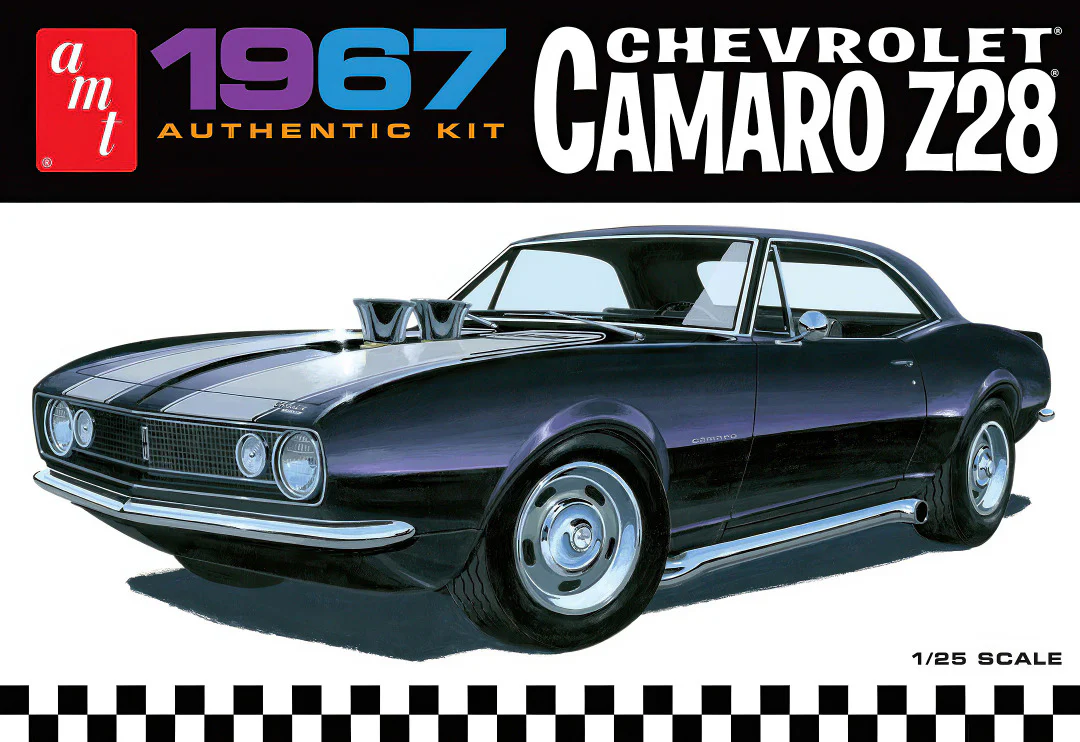
Description
Scale: 1/25
Barcode: 849398052907
The first-generation Chevrolet Camaro is an American pony car introduced by Chevrolet in the fall of 1966 for the 1967 model year. It used a brand-new rear-wheel-drive GM F-body platform and was available as a 2-door, 2+2 seat, hardtop, and convertible. The F-body was shared with the Pontiac Firebird for all generations. A 230 cu in Chevrolet straight-6 was standard, with several Chevy V8s available as options. The first-generation Camaro was built through the 1969 model year.
The Z/28 option code was introduced in December 1966 for the 1967 model year. The Z/28 featured a high-output small-block 302 cu in (4.9 L) V8 that had been designed for competing in the 5 litre (305 cu in) class of the then-popular Trans-Am racing series. It had a strongly over-square, high-revving 4 in (101.6 mm) bore and 3 in (76.2 mm) stroke, with an aluminum intake manifold, and a 4-barrel vacuum secondary high-volume 780 cfm Holley carburetor. It took Ford until 1969 to mount a head-to-head competitor: the Boss 302 Mustang.